
Key facts
- Who is Tomasz Czajka: Dubbed a legend of programming competitions. Two-time gold medalist at the International Olympiad in Informatics, four-time winner of the TopCoder Algorithm international programming competition, and ICPC World Champion in team programming. One of the protagonists of a popular Polish meme: “programmers’ party.”
- Family: Born on May 21, 1981, in Stalowa Wola. His parents and two brothers are also programmers. His son programs as well. Only his sister graduated in medicine.
- Education: Graduated from KEN High School in Stalowa Wola. Scholarship holder of The Polish Association for Gifted Youth (now: The GIFTED Programme). Graduate of the Faculty of Mathematics, Informatics, and Mechanics at the University of Warsaw.
- Career: Worked at Google and SpaceX. At the latter, he worked on, among other things, the navigation of the Dragon capsule. Currently, he is pursuing his own projects: building a platform for learning programming and developing a new programming language.
Michał Karbowiak: Have you seen the new, flying Tesla Roadster?
Tomasz Czajka: I have. The people at Tesla must have had a lot of fun with that.
Fun?
In my opinion, they did it for fun, to have a cool demo of the new Tesla. I don't think cold gas thrusters will be used in new commercial cars.
You can already order such a Tesla; production is reportedly set to start in 2028.
We’ll see. To me, they did it to make it look “cool.” I have a similar story from SpaceX. I wasted six months working on something that ultimately wasn't used.
What was it?
At SpaceX, I worked on Dragon, which is a capsule - a spacecraft. It’s mounted on top of a rocket, such as Falcon, and after separating from it, it orbits Earth to reach the International Space Station. Initially, the plan was for Dragon to return to Earth and land on rocket thrusters onto a concrete landing pad…
So not on a parachute?
From an operational perspective, that would have made it easier to reuse Dragon’s parts. When the capsule lands on a parachute in the water - as it currently does - corrosion can damage some of the components. But if you asked Elon Musk why we had to land using thrusters on concrete, he would quite seriously add another argument.
Which is?
Have you ever seen aliens in a sci-fi movie land on Earth on a parachute, splash into the water? How would it look if an “Alien” fell into the water? It wouldn't get any respect (laughs).
“Have you ever seen aliens in a sci-fi movie land on Earth on a parachute, splash into the water? It wouldn't get any respect.”
Did Musk really argue like that?
For him, it’s genuinely important that the landing looks good, that it’s “cool.” We worked on it for a long time, but the process isn't feasible for now. So we’re left with the parachute (laughs).
Musk’s attachment to appearance and aesthetics is also reflected in Dragon’s interior design. Everything in black and white, straight out of a sci-fi movie. It can’t be crude and utilitarian, like in Russian Soyuz capsules. It has to look beautiful.
Attention to detail, or a kind of madness, even childishness? Sci-fi movies as a point of reference for an inventor?
To me, those looks wouldn't matter, but I respect that someone has a different approach.
Me and Elon Musk
What is Elon Musk like?
I don’t know him well. While working at SpaceX, I had maybe three meetings with him a year on average. I know people were afraid of him; some even treated him like a God. The fact is, you could get fired from the company even right after a conversation with him. He has no patience for people and hates it when someone talks nonsense.
Were you afraid too?
It didn't faze me. I think I’m a bit “on the spectrum” - I don't pay attention to social conventions, I have trouble reading human emotions, and I always answer directly. I prepared well for meetings with Elon; I stated specifically what we were doing, what was blocking us, and how we could solve it. He respected that. Once, I actually thought I was going to get fired, and instead, I got additional support.
Why would you have been fired?
I had to tell Elon that the Dragon navigation software I was supposed to prepare was only 1/10th done. And there wasn't much time left until the planned mission; it could have been significantly delayed. There was simply too much work for one person. Instead of firing me, Elon accepted my arguments, created a special team, and made me its leader. The mission ended up launching later for other reasons anyway.
Maybe you got lucky, because Musk is more of a brilliant engineer than a programmer. He had to take your word for your reasoning.
He doesn’t know code in detail the way I do, but he has vast technical knowledge - much greater than most people who aren't in the trenches. I always got the impression he knew what I was talking about and was capable of making the right, fast decision. He might have his eccentricities, but from my perspective, he is hyper-rational. Sometimes he says things very bluntly, and that’s why people perceive him that way.
“He might have his eccentricities, but from my perspective, he is hyper-rational. Sometimes he says things very bluntly, and that’s why people perceive him that way.”
On Kanał Zero, you said that at SpaceX they do everything “on the cheap.” Is Elon Musk a corner-cutting businessman?
(Laughs). That’s actually an argument for why he builds a good project. SpaceX doesn't need procedures for special equipment or bureaucracy; sometimes they just wing it. When NASA built the Space Shuttle, everything was insanely expensive. Because they had to have ideal equipment, a massive team, multiple redundancies, tons of tests, and procedures - which, by the way, didn't work anyway.
Maybe they prioritized safety out of a sense of responsibility?
Maybe they have to operate that way because it’s a government project? But were they effective? Not always. At SpaceX, we also operated to ensure everything succeeded without harming anyone. Yet we achieved the result at a much lower cost.
The Space (Non-)Hero
You worked on the navigation of Dragon, the space capsule, but you also saved a Falcon launch - the rocket.
Well, yes. It turned out a piece of computational software was running too slowly, which in a worst-case scenario could have led to a loss of control and triggered the rocket's self-destruct mechanism. I searched for the cause all night and succeeded. Falcon was able to launch on time. It only took changing five lines of code. Knowledge of algorithmic theory I gained at the University of Warsaw helped me.
You became a hero.
Let’s not exaggerate. Though Elon actually did praise me in an email to all employees. But what I’m truly proud of are the specifically technical things I did at SpaceX. It’s a shame I can’t talk about them freely and in detail because they’re classified.
“Though Elon actually did praise me in an email to all employees. But what I’m truly proud of are the specifically technical things I did at SpaceX.”
Can you describe them without details sensitive from SpaceX’s perspective?
For a year, for example, I worked on an algorithm that calculated Dragon’s far-field rendezvous trajectory to the International Space Station.
Meaning from the moment Dragon is already in orbit, after separating from the rocket.
At that point, it’s in the space station's orbital plane, yet still far away from it. It might be on the other side of the Earth. It has to execute a series of maneuvers that are quite complex to model mathematically in order to fly up to the station over a dozen or several dozen hours. From the outside, it seems like no big deal. But it’s a wildly complicated process. It’s crucial to execute it optimally, using as little energy and fuel as possible.
What else are you proud of?
Another process I was involved in was Dragon docking at the space station. Initially, tests showed it wasn't going too well. Sometimes Dragon wouldn't hit the docking port with the right force and precision. There was a risk it would crash into the space station and damage it. I proposed using a completely different algorithm than had been used up to that point. Nobody had ever done that in space before. Thanks to that, we managed to carry out the entire operation more efficiently and with much greater precision. And keep in mind, in low Earth orbit, that’s much harder than deep in outer space.
Why?
Because in that closer space, Earth also exerts gravitational and atmospheric forces on Dragon and the space station, and the vehicles behave differently. I knew this because while working at SpaceX, I got interested in orbital mechanics and read a few books. Most programmers didn't understand what was actually happening up there.
Work at SpaceX haunted your dreams at night.
I worked all day, from morning till night, and on weekends too. But that suited me. I had no family obligations on-site because my son and ex-wife were already back in Poland. Otherwise, that kind of time commitment to work would have been impossible. What bothered me, though, was that I couldn't do other projects or enter competitions. I could and had to focus solely on SpaceX. That burned me out more than the sheer workload. I like programming for fun; it helps me.
“I worked all day, from morning till night, and on weekends too. But that suited me.”
Is that why you left the company?
Partly. I left twice - first when they wouldn't give me a “sabbatical,” a break of several months that, as I believed, I was entitled to under my contract. So I took that break myself. Afterward, I returned to SpaceX and worked on Starlink, specifically positioning satellites in orbit and planning their trajectories. Domain-wise, seemingly similar to what I did on Dragon, but technically it works completely differently. Since ending my collaboration with SpaceX, I’ve been working on my own terms.
The Master and the Coding Platform
What are you doing today?
Little hobby projects; probably nothing will come of them.
Tell me about them.
For example, I’m building a website for learning programming and algorithms. I’d like kids in many countries to be able to learn from it. Back in the day - while still studying at the University of Warsaw - I ran open classes for high schoolers, an introduction to algorithms. I didn't teach a specific programming language; instead, I created the simplest possible computer simulator so you could fully understand what was happening inside. You learned by executing consecutive steps, like stacking blocks. I gave homework and built a testing server. And I was surprised, because turnout was so massive we had to move to a larger lecture hall. Some kids even organized themselves and traveled all the way from Gdańsk.
“I’m building a website for learning programming and algorithms. I’d like kids in many countries to be able to learn from it.”
A huge success.
Later, I got emails saying someone got inspired at my classes and started doing a PhD in computer science. Nice. I thought that now I’d build something similar, only the whole thing would be better designed. Teachers and students could use it in schools.
For free?
I think so. I haven't thought about it in detail. The most important thing is to show that you can do interesting things without acquiring complicated knowledge first.
What other interesting things are you doing?
I designed a new programming language; I have everything thought through and mapped out. It’s not a simple project, but I believe this language will be the best among those currently available. Though I don't know if people will want to use it. With programming languages, you need a network effect. Quality isn't strictly what matters. That’s why, for instance, at SpaceX they still program some things in C++, even though it has tons of flaws.
You could use your worldwide reputation to promote it: four-time TopCoder Algorithm winner, ICPC World Champion…
Maybe… I do a lot of projects. Sometimes I think it would be better to focus on one and work in a team. When you’re at SpaceX, you have the entire infrastructure and lots of smart people. The rocket is there, the processor is there, there’s a separate testing team. All you have to do is write the code. That’s more productive. On the other hand, I like programming alone, inventing problems and solving them. Now nobody dictates anything to me, and I have more motivation. I don't know, we’ll see how it turns out.
Tomasz Czajka and the Viral Meme
Marcin Żukowski, who co-founded Snowflake - currently worth around $100 billion - called you a “genius” in an interview on Polish Tech Minds. Professor Piotr Sankowski - president of the IDEAS institute and a widely respected authority in AI - added in the book RzeczpospolitAI: “a legend of programming competitions.” Yet you remain very detached about your ideas.
People give me a bit too much credit. Various things combined to make me famous in Poland. I think it’s partly a matter of the famous “programmers’ party” meme, and partly the competitions. But I also don't quite know how it happened.
Let’s recap: you’re an International Olympiad in Informatics gold medalist, you won international programming contests, you became a world champion in team programming, and you worked at Google and SpaceX. Surely that’s where the well-deserved fame comes from.
Well, yes, but over 20,000 people work at SpaceX; there are probably some other Poles. And at Google, definitely. It seems to me it’s that meme.
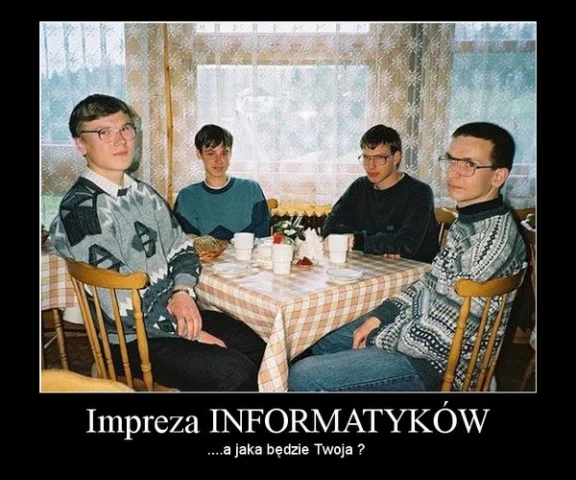
Does it make you laugh?
Sure. Though the popularity of that particular photo is a bit strange. It doesn't look any different from many others from camps or retreats from that era. That was '97; it seems to me people wore sweaters and glasses like that, and also sat at tables covered with oilcloth. Maybe some specific elements aligned so that this exact photo gained massive popularity. I don't know.
Were you embarrassed by it?
No…
Did you show the meme to your son?
It’s possible he showed it to me. We talked about it, though I don't remember the details.
Does your son program too?
He competed in the Junior Olympiad in Informatics, for elementary schools, and did well. He became one of the laureates.
You’re on the main committee that prepares that Olympiad.
Well, yes. But when my son competed, I wasn't yet. Now he’s in high school and will compete in the high school Olympiad. I suppose as a father I got him hooked on a topic I’m passionate about myself.
It must be tough having such a famous father and constantly being compared to him.
You think so? I hope he’s mostly just enjoying coding. Though maybe he feels that pressure? I don't exert any; I’m just happy with what he’s doing. I’m also glad we simply have something to talk about. Algorithms and programming are part of our relationship.
Your parents are programmers too.
Mom is retired, but Dad still programs. My younger and older brothers do as well. All three of us graduated from the Faculty of Mathematics, Informatics, and Mechanics at the University of Warsaw. Only my sister went into medicine. Though when my brother and I were writing a game once, we asked her to draw the graphics for us.
Do you mostly talk about computer science in your family?
A lot about math. But let’s not exaggerate. We do normal things too (laughs). When I’m together with my dad and my son, we play board games, like Ticket to Ride or Terraforming Mars.
Elon would be proud.
(Laughs). Sometimes the three of us program together too; my son enjoys doing it with my dad. I cracked up when I heard: “Grandpa, you’ve got a bug right here.”
Were you a nerd as a teenager?
I was a bit, and I still am. Interpersonal relationships come harder to me. Math is easier. A lot of people in math or computer science are similar, which is why they’re deep into it. As for childhood, I think in 5th grade I joined The Polish Association for Gifted Youth (now: The GIFTED Programme), which organizes science camps for gifted youth - even during the school year. From then on, I signed up for every possible trip. It wasn't even about what exact things we were learning there. I liked the idea of meeting kids from all over Poland interested in various fields. And for me, it was an escape from everyday life, from school. I spent a large part of the year at those camps.
“Interpersonal relationships come harder to me. Math is easier.”
Your parents didn't mind?
They said: do what interests you. I try to do the same with my son.
Do you ever wonder what the world will look like when he grows up?
Sure, though it’s very hard to predict because we have the artificial intelligence revolution. When people ask me what we should teach in schools or universities, I don't have a good answer. There’s a decent chance AI will be smarter than us in the future. Maybe we’ll delegate most mental tasks to it? Does that mean it’s not worth learning? No. It’s worth knowing how the world works - out of pure curiosity.
I don't know if everyone has that at your level.
I don't know how I would behave if I were a teenager today. But when I was my son’s age, starting high school, it also seemed like the world was changing dynamically. Back then, I didn't wonder what job I’d be looking for in the future. I did what I had fun doing. I advise him to do the same.
Tomasz Czajka vs. Jakub Pachocki
People who could globally influence the future development of artificial intelligence include Wojciech Zaremba and Jakub Pachocki, co-founder and Chief Scientist at OpenAI, respectively. Do you know each other from programming competitions or academic Olympiads?
Yes. In Poland, there’s a kind of subculture around the Olympiad in Informatics. The sheer number of people competing in it is a global phenomenon in its own right. So we know each other from the scene, and Wojciech Zaremba even wanted to recruit me to OpenAI back when he was building his “Polish mafia” of acquaintances there.
“Wojciech Zaremba even wanted to recruit me to OpenAI back when he was building his “Polish mafia” of acquaintances there.”
Why didn't you agree?
I had a good job and things to do at SpaceX. Besides, at that stage, I wasn't that heavily interested in artificial intelligence yet. That topic was essentially foreign to me. With Jakub Pachocki, we traveled to various programming contests and competed there.
Who won?
We took turns, I think. I remember a 24-hour programming contest in Budapest. At that particular one, my team took first place, and his team took second. I’m older than Jakub - I was already in my thirties - but I decided to return to competing because I liked the idea of coding for a full day. You don't sleep; you just hack and write code.
The old master beat the rising star.
Nah, my team just happened to win that time, that’s all. But if you’re looking for a Polish genius, Jakub Pachocki is someone like that. He always had brilliant ideas. I remember even at that competition we won, I was struggling with a problem for two hours, and he came up with a completely wild idea that turned out to work way better.
Even after finishing your work at SpaceX, you didn't want to join the OpenAI team?
Lately, I’ve been thinking about messaging a few people at companies like that. Maybe I could be useful? Maybe OpenAI, maybe Anthropic, I don't know. I’d definitely have a bigger impact on the world there. I miss that a little bit.
You’ve already worked at software giants. About Google, you once said: “If I did nothing there for six months, nobody would notice.”
Google is a massive corp. They themselves don't know who’s doing what (laughs). But I liked that job; I learned a lot - probably more than I contributed to the company myself. For me, it was more of an extension of university. Google resembled an academic environment - lots of classes, lots of lectures. I did get something done there, though.
What specifically?
My first project was probably my biggest success. Google had massive resources, but also massive tasks to execute. And resources were allocated to tasks practically by hand. If the Google Maps division wanted to run large computations and needed tens of thousands of servers for it, someone from the Google Maps team would specify the number of servers and their specs, and someone else would figure out which exact servers to use for it. As part of a small team, we developed an algorithm that automated the allocation of resources to projects, and did so in a maximally efficient way.
I assume Google saved hundreds of millions, if not billions, of dollars on that.
Considering it was a global project, that could be the case.
You never got a job offer in Poland? After all, you started achieving success as a teenager, and you took the job at Google at age 26.
I don't think I got any offers. Besides, back then in Poland, practically nobody was building software or digital products at a super-advanced level. Now there are startups doing cool things, though obviously still not on the same scale as in the US. A SpaceX or a Google likely won't emerge here, because nobody will invest such massive funds. Still, I even invested in one Polish startup myself. Who knows, maybe it’ll become a unicorn (laughs).
Michał Karbowiak
Journalist and business specialist covering stories that global media usually miss. He connects Polish innovation with a global perspective.
LinkedIn