
Key Facts
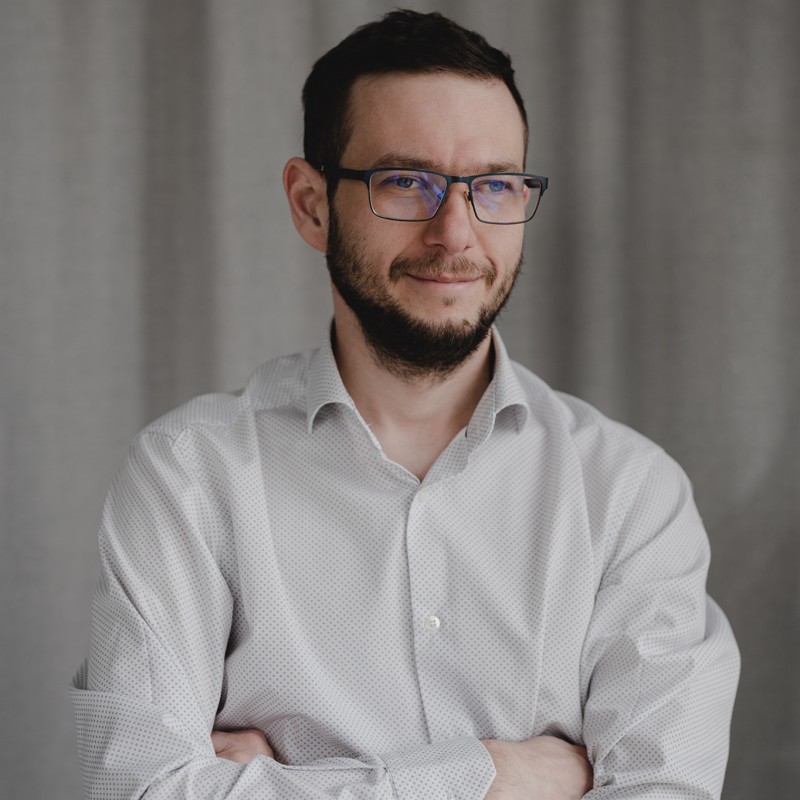
- Who Aleksandra Pędraszewska is: Investor and entrepreneur, partner at the Vastpoint fund, and previously co-founder of a deeptech startup and one of the first 40 people at ElevenLabs.
- Work at ElevenLabs: She met the founders – Mati Staniszewski and Piotr Dąbkowski – back at Copernicus High School in Warsaw. At the company, she was responsible for areas including product safety. Currently, ElevenLabs is valued at $22 billion.*
- Vastpoint: Together with Karolina Kukiełka and Zuzanna Brzosko, she runs a VC fund created with the participation of PFR Ventures.
Michał Karbowiak: Does someone often ask you for an intro to ElevenLabs?
Aleksandra Pędraszewska: Something related to ElevenLabs comes up probably a few times a week but in very different contexts. I help if someone has a cool, concrete piece of business to do, has found the right person on the company team, and has a specific request for them. Or if their startup might qualify for the Startup Grants program run by ElevenLabs.
However - speaking very candidly - I don't really make direct intros to the founders: Mati Staniszewski or Piotr Dąbkowski.
Are they too busy? In the book “RzeczpospolitAI”, Mati Staniszewski revealed that since founding the company, he hasn't really had a day off.
That’s true - they work really hard and deal with topics not directly related to the company, like angel investments, strictly on weekends.
Exceptional Class F
Aleksandra Pędraszewska: investor, partner at the Vastpoint fund, former co-founder of the deeptech startup VividQ, classmate of the ElevenLabs founders from Class F at the XXXIII Nicolaus Copernicus High School in Warsaw. Is the latter a blessing or a burden in the Polish ecosystem?
Looking at my professional career path - a blessing. I was very lucky to meet a group of exceptional people early on in school, and thanks to that, among other things, I could watch ElevenLabs' success up close before it became a globally recognized brand.
I'm also glad that "despite" these many international successes, we are still actively working in the Polish startup ecosystem. Mati himself has backed dozens of projects run by Poles, and we also manage to co-invest. For example, we joined the funding round for Replenit, a company building AI tools that allow brands to reach customers at the right moment and through the most effective channels. I invested in the company on behalf of Vastpoint, Mati privately.
How much did Copernicus High School shape you and the creators of ElevenLabs?
I'll warn you right away: you won't hear school anecdotes about the guys from me (laughs). Personally, I don't feel shaped by the school as an institution. Rather by the people I met and had around me.
They ended up there for a reason - even though our high school was a public school, almost exclusively people with top exam scores or achievements in academic olympiads got into our class.
This is a crew of people who, at the age of 15, decided to take the International Baccalaureate to have a chance to study at the top universities in the world.
In a conversation with Tomasz Świeboda from Innovo VC, you said: “At practically every stage of education, I had some conflicts with the administration or with the generally accepted system.”
I guess it's a bit like this: if you want to change reality, you have to disagree in some way with the rules you find in it (laughs). I don't accept the „because I said so rule” I want to know why something works one way and not another, and whether it's worth changing. That's a trait I also look for in the best startup founders.
But it's not like all elements of the Polish education system are bad. It's our great strength that success is still determined, to the greatest extent, by the willingness to learn and the effort put in, rather than background or money.
We owe this to the strong position of certain public schools - that's why you often hear about Copernicus or Batory in Warsaw, or Trójka in Gdynia. At the same time, in the educational process - systemically - we strive for averaging out. Sometimes almost by force. Meaning if you're bright and pick things up faster...
…then you might have problems, like say Jakub Pachocki from OpenAI, whom they wanted to expel from school.
Exactly. If you finish faster, you're more likely to get scolded for disturbing others than given a new task that could be a challenge for you.
You finished high school with a principal's reprimand on your record. What gets you a reprimand?
That's a direct consequence of what I mentioned earlier - when the administration, without giving a reason, made a decision that as students we couldn't leave the school building during school hours - regardless of whether we had a free period at the time - we viewed it as an invasion of our student freedom (laughs).
So it became a kind of game to leave the school without anyone noticing. It was about breaking a rule that made no sense to us. That's one of the reasons why I finished high school with a principal's reprimand.
Were Mati Staniszewski and Piotr Dąbkowski also rebellious?
Mati was the student council president, so he got along a bit better with the teachers (laughs).
When Mati showed your class photo while kicking off the ElevenLabs Summit, I noticed that there were a lot of you in it.
Our class was indeed very large, over 40 people attended it. With some people I actually had no classes together if they chose different subjects for the IB and were going into, for example, medicine.
Together with Mati and Piotrek, we belonged to a group that quite quickly decided they wanted to go to top British universities. Mati to Imperial College London, Piotrek to Oxford, me to Cambridge. Every one of us made it.
That group of people fascinates me. You along with Mati Staniszewski are on the Future Council of the Polish Prime Minister, Mati himself is on the advisory council to the President of Poland, and Piotr Dąbkowski was recently invited to join the Rhine Group - a think tank established by Mario Draghi to save the EU economy's competitiveness. An incredibly influential network.
To be honest, I'm also sometimes surprised by how the fates of this graduating class unfolded (laughs).
There were really a lot of incredibly talented people in our class who are now doing interesting and valuable things in Poland and around the world. As it happens, the three of us appear in the media most often, but many people from that class photo inspire me every day.
ElevenLabs: The Road to Excellence
The story of your acquaintance didn't end with high school graduation. The founders of ElevenLabs became your superiors many years later when you joined the company.
We stayed in close touch during and after our studies. I was lucky enough as one of the first people to see the first ElevenLabs demo, where Leonardo DiCaprio spoke with the voice of Kim Kardashian, Steve Jobs, or Joe Rogan, back when Mati and Piotr were working on it in a rented Airbnb in Warsaw.
I already knew then that my time at the startup I was building was coming to an end. After the guys raised their first funding in the summer of 2023, we could finally meet at their office (laughs). Ultimately, I officially joined the team in February 2024.
That was a critical moment, because in January 2024, a deepfake of US President Joe Biden's voice was created. The fake clone was supposed to encourage voters in the state of New Hampshire to abstain from voting in the Democratic primary. What did your work on mitigating abuse consist of?
It was clear then that safety was one of the key operational areas of the company. I co-created product usage rules for users and technological safeguards designed to protect ElevenLabs from similar issues: deepfakes, impersonation, or other unauthorized applications.
Did it succeed?
I think so. Although the most thankless element of product safety work is a certain paradox: if nothing bad happens, you've done your job well. But at the same time, you never know what could have happened without your hard work.
Safety is also a business issue, a matter of your credibility in relations with investors, media, and most importantly - with clients, whether from the consumer (B2C), business (B2B), or government (B2G) sector.
Did you know from the beginning that ElevenLabs would succeed in the B2B or B2G segment? At the start, it seemed to me that the product was tailored more to the needs of individual creators, i.e., B2C.
Seeing from the inside what this product "can do", what value it can bring to a client, I had no doubt that it would work in business or in applications indicated by public administration.
The company was growing at an unimaginable pace: when I started in February 2024, there were 40 people in it; when I finished in July 2025 - 400.
Tell us about those dynamics seen from the inside.
It's a unique experience. Remember that earlier, at VividQ, for seven years I worked in a company where you didn't just have to sell across various cycles, but actually educate the market.
At ElevenLabs, the demand for the product was actually much higher than the capacity to deliver subsequent versions. That came with - and probably still comes with - incredible intensity, maximum level of requirements, and an expectation of excellence in every area.
ElevenLabs Closer to Poland
How did you navigate that?
Well, although the dynamic development of the company brought various changes. The safety team moved to San Francisco after the US election, and I didn't want to leave for the States.
I knew that by moving from London to Warsaw, I was approaching an "exit" sign at ElevenLabs. But first, Mati and I decided that I would help build a network of partnerships in Poland.
Something that the company today calls "a return to the place where it all started."
The goal I set for myself was to increase ElevenLabs' engagement in the ecosystem. To support specific initiatives: the AI Olympiad, the ML in PL conference (a large machine learning event - ed. note).
It was about building a real bridge of understanding between the company and Poland, reducing a certain natural distance. So that this relationship wouldn't end at "the company was founded by two Poles."
I am very proud of what we managed to do, and I'm glad that these activities are being continued and reinforced.
I also experienced firsthand what it means when customers crave your product. They are convinced to buy or collaborate after a 20-second demo. An incredible feeling. I'd like to return to a product company someday and experience something like that again.
Can you imagine ElevenLabs losing its market position?
That's a broad question. There is much discussion about what comes next at the point where voice models pass the Turing Test - meaning the generated voice is indistinguishable from a human voice.
In the era of AI agents, the battle is now fought on the speed of speech generation, but price competition is also becoming increasingly visible. Will this lead to the commoditization of models? And if so, will a broad expansion of the application layer be the most important technological advantage? What significance will brand trust and business credibility hold?
What future do you see for ElevenLabs?
I believe it will successfully navigate these key challenges for the AI market and permanently enter the group of the world's largest technology companies.
Cambridge: Like in Harry Potter
What does it feel like when your story is told in a speech in Parliament by Minister of Foreign Affairs Radosław Sikorski, while President Karol Nawrocki and Prime Minister Donald Tusk listen to the whole thing?
It's a great honor.
Did you feel stressed?
Honored, rather. After all, it's not every day that a minister points to you as an example of the "Talented Poles are returning to the country" trend. But honestly, what I would care about most is for there to be as many such stories as possible. I believe that as our ecosystem develops, that's exactly what will happen.
You and Sikorski happen to have somewhat similar biographies. He graduated from Oxford. You say of yourself: Shaped by Cambridge.
Getting into Cambridge was a huge dream and a goal that defined my educational path. But at the university itself, I got even more than I expected.
Knowledge?
Opportunities for personal growth. For the first time, I felt that if I wanted to pursue things that were important and interesting to me - outside of academics too - I didn't have to fight for it. What's more, I would even get additional support.
What kind of support?
Institutional, but also human. At Cambridge, during undergraduate studies, it was a bit like Harry Potter. In Hogwarts, students belonged to houses; we belonged to specific colleges.
It's the place where you live, but also an environment that takes care of you. My college happened to be all-female.
In the Vastpoint fund you also have only female partners, so I'm not surprised.
Then I'll surprise you. Earlier, before university, I had mostly male friends. But I went to that college because an acquaintance of acquaintances studied there, probably the only person I knew at the entire university at the time. And I don't regret it - you could really feel the "female power" and mutual support there.
If I wanted to go to a cool conference in London, I could count on getting funding for the train, which mattered on a student budget.
If I achieved good academic results or completed a cool social project, I would find a nice congratulatory card from my college.
I felt noticed, appreciated.
A Long Road to Business
Going into university, did you know you would become an entrepreneur?
Back then, I had no idea what entrepreneurship was, nor consulting or investment banking. Even less about startups - they were hardly talked about at all.
So where did business come from?
A long road led to it. I always liked organizing, creating: conferences, plays, a website.
Back in high school, I took part in the Social Projects Olympiad, where I learned the basics of project management.
In university, I was super involved in the Polish society at Cambridge. We executed a whole bunch of initiatives that in a way animated that community...
Still a long way from running a business.
Earlier than running a business, I got interested in technology. Toward the end of my undergraduate studies, I thought I could leverage it academically, but also in terms of professional career development. In my bachelor's thesis, I analyzed, among other things, how tech companies develop in Cambridge.
And why did I do that? Because thanks to that, I could set up interviews with twenty or thirty CEOs of tech companies in Cambridge and understand what they were actually doing.
Were you hoping they would give you a job?
Not directly - it was a way to get inspired. Besides, the operations of those tech companies struck me as interesting.
For my master's degree, I went specifically into "Technology Policy," a program that combines the analysis of the innovation sector with public sector activity, as we would say in Polish.
We learned through concrete examples how the government can support the startup ecosystem or where the "invisible hand of the market" works best. That probably explains, in some sense, why today I operate at the intersection of business and the public sector, or why I got involved in the Future Council alongside the Prime Minister.
Big Tech? A Dream and a Disappointment
Yet that doesn't fully explain how you became the co-founder of VividQ, a startup creating software for 3D and holographic displays.
Before that happened, I dreamed - like everyone else back then - of working in big tech. Negative opinions about them only appeared later. When I was finishing my studies, the best thing that could happen to you was working at Google.
Did you try to get in there?
I applied to DeepMind, which had already been acquired by Google, but when the HR lady explained to me what my work would look like over the next few years, I felt like I was going back to school. As in: these are the thresholds, this is the program you will go through, after the second year you must know this and that.
That's surprising. DeepMind back then seemed elite, avant-garde in the tech industry.
I was in love with the concept; I thought they were doing amazing things. I even attended a meeting with Demis Hassabis back in college, where maybe 30 of us chatted with him over a glass of wine.
But during the job interview, it turned out that the junior project manager position I applied for really felt like school. The HR lady admitted that I'd probably do better in a higher role, but she couldn't hire me for it because I lacked experience.
What did you do?
Maybe what I thought is even more important. Above all, I realized that working in big tech was not my dream because it happens within a fairly rigid framework. I also understood that I had to create my dream job myself to some extent. Because I guess I'm not cut out for any other (laughs).
VividQ – The Revolution That Didn't Happen
How do you create a dream job?
Coincidence worked - as always - though I helped it along a bit. What led me to VividQ was a conversation with an acquaintance who was... the photographer for the Polish society at Cambridge. Once, he casually told me about a project he was creating as part of his PhD at the Photonics Department. He asked me for help preparing a presentation for an upcoming conference.
And so from a presentation to a company?
We had complementary skills. He and his lab friends had the tech. I had the organizational and - as it turned out later - business skills. At that stage, that was enough to start a company.
Sometime later in the media, you argued that holographic displays, for which VividQ creates software, are among the fundamental technologies allowing for the mass adoption of augmented reality. You claimed that in the long run, such a display could appear in virtually every device we use. We were supposed to view everything in 3D, even without needing to put on goggles or a special headset.
There were grounds to think so. But the revolution in the form of widespread adoption of augmented reality solutions didn't happen. We expected that market to be much, much larger - not even so much in terms of value, but in the context of real usage of specific solutions by users. A new wave of consumer devices didn't happen, the ways we interact with the digital world didn't change....
Which the AI revolution is bringing.
Exactly. That's why absolute giants will grow on it.
What would investor Aleksandra Pędraszewska say today to that founder Ola Pędraszewska back then?
A lot of things. Among them: to start raising money from VC investors, you first need to clean up equity issues. At VividQ, we lost a ton of time and money due to a problematic cap table dating back to our first major investment from a business angel, which could have realistically cost us our market position.
The Vastpoint Fund
If the investor had been your current fund, Vastpoint, would it have succeeded?
Certain things we definitely would have done differently, better. But success depends on a huge number of factors: luck, timing, human factors, macroeconomic factors, the global situation.
How significant to creating the Vastpoint fund, with a large stake from PFR Ventures, was your work at ElevenLabs?
ElevenLabs opened many doors for me, but when launching the fund, my experience with VividQ was much more important, where I was responsible for fundraising and investor relations. Besides, I'm not building the fund alone. At Vastpoint, I work with two great partners: Karolina Kukiełka and Zuzanna Brzosko.
Karolina spent seven years investing in startups as part of London-based fund InReach Ventures. Zuza built her biotech startup at Y Combinator, and also worked at places like Goldman Sachs and the M&A transactions team at pharma giant Eli Lilly. I think it was this mix of skills and experience that convinced PFR, as well as other investors, to work with us.
Of the three of you, you are the most active publicly and on social media. Some might say you are a “self-proclaimed ambassador of the Polish tech sector.”
We have achieved huge success over the last two decades as a country, but also specifically as a Polish business community. Despite that, we are still not good at talking about this success. Even people who have accomplished truly great things in their careers fear being accused of "bragging." That's why I'd personally like to see more and more such people taking on the role of ambassadors.
Recently, Artur Wala, founder of the Polish communities AI Tinkerers and GTM Tech Week, called me Matka Polka Technologiczna ["Technology Matka Polka" – a Polish play on words referring to a deeply engaged, caring woman who also promotes patriotic values – editor's note], which amused me greatly, but I also liked it enough that I proudly put that title in my bio on X/Twitter.
Pressure? I Put the Greatest Pressure on Myself
And does activity on many fronts not distract you from what's currently most important - effective investments?
Being an ambassador, activity in foreign media, promoting Poland, the economy, and the ecosystem is important to me from the fund's perspective as well. These roles complement and fuel each other. For example, I care that foreign funds see that we have great companies in Poland and want to co-invest in them with us.
If the Chief AI Officer from Singapore calls me because he's coming to Poland and wants to understand the ecosystem, I consider it my duty not only to meet with him. It's also a duty to think about who else should be at the table.
As for investments, every week I review a ton of companies that apply to us directly, as well as those coming from my market analysis alongside an entire team of AI agents. Meanwhile, combining the role of ambassador and investor provides what's most crucial in this business: access. Access to the best people, to the best investors, to potentially the best future clients for my startups.
Does such activity not put additional pressure on you? If you failed to build a good portfolio of startups, people would say: it's because she was sitting on LinkedIn or attending events.
Pressure? The greatest pressure is the one I put on myself.
I'll evaluate my effectiveness in a few years, from the perspective of the entire portfolio. And the fact that someone might criticize me? For 15 years, whenever I've appeared in the media, I've clashed with - almost always anonymous - hate, and I would have to give up most of the projects I do to avoid it.
As a partner at Vastpoint, I'm mainly interested in how the AI market behaves over the years and how much my companies will be worth then.
Is it easy to find good companies to invest in? Sometimes VC investors complain: we have the money, we're just lacking interesting projects.
There are more and more good founders and projects in Poland. But we are looking for excellent ones. The bar is set really high.
Is your dream to find the new ElevenLabs?
I think more systematically. I'd like Poland to be an attractive place to live and work for people building global tech companies. Because whether a company is registered in Poland or another country is decided by a lot of people and factors. It doesn't even have to be the founders' decision, but that of investors, the board of directors, or a tax advisor.
In an ideal world, I would like to see - probably while deploying the next fund at Vastpoint - another wave of companies in the Polish economy founded by people with experience from companies like Booksy or ElevenLabs.
I would like people who worked there to build something of their own based on the experience they gained. Next great companies.
And to have their former co-workers support them in doing so.
And I could invest in those ventures and watch them grow.


