Key facts
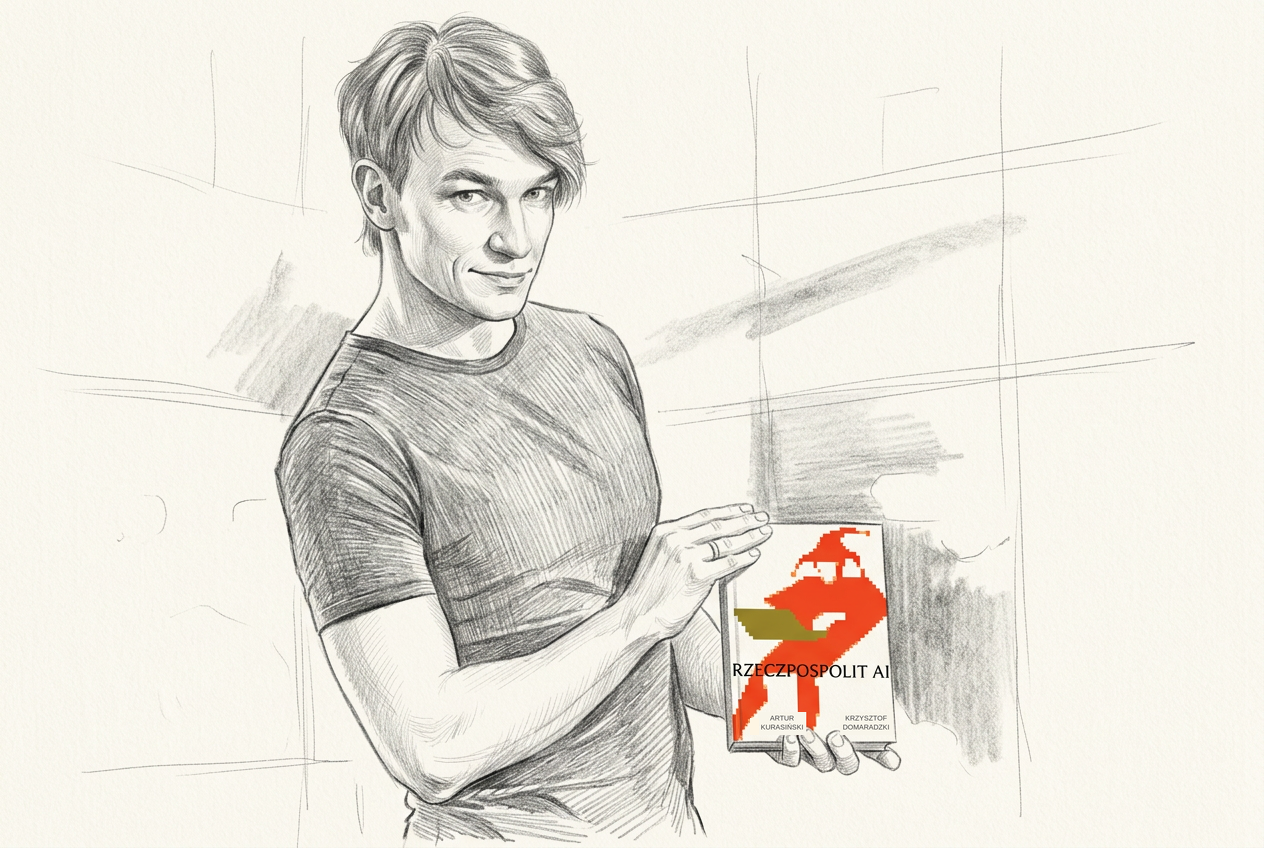
- Who is Krzysztof Domaradzki? Deputy Editor-in-Chief of the Polish edition of Forbes, journalist, author and screenwriter. He writes about startups and new technologies. Creator of the well-known "30 Under 30" list.
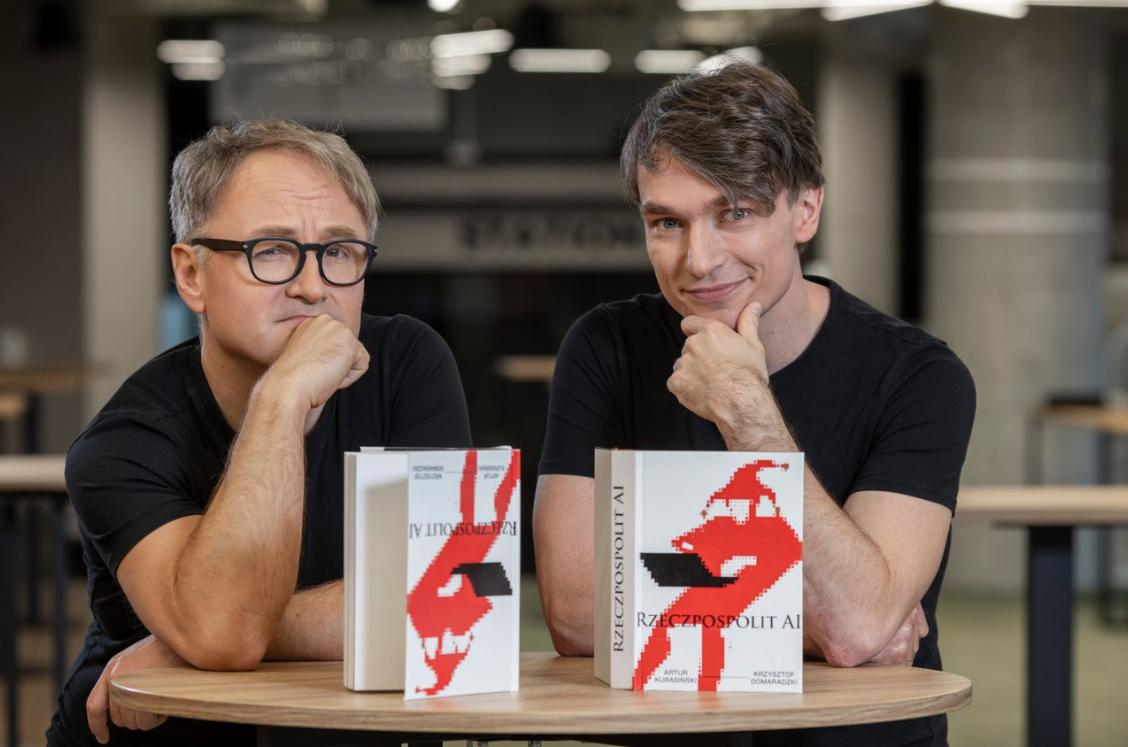
- The book RzeczpospolitAI: co-written with Artur Kurasiński, entrepreneur, investor and tech analyst. It features 17 conversations with the people shaping Polish AI.
- From the authors: "We wanted to write a book about Poland. About our great opportunity arising from the artificial intelligence revolution. An opportunity we can spectacularly seize or squander."
Michał Karbowiak: May I commit a little plagiarism?
Krzysztof Domaradzki*: Off to a good start (laughs).
I’m going to ask you a few of the questions that you and Artur Kurasiński posed to your interviewees in RzeczpospolitAI. But I want to hear your answers, not theirs.
Be my guest.
What do you feel when you think about artificial intelligence? Fear or hope?
More hope than fear. But I feel a bit of both.
Is the extinction of humanity a realistic scenario?
If Nobel laureate Geoffrey Hinton - often called the godfather of AI - claims there is such a danger, I'm not going to dismiss it. Hinton puts the probability at 10 to 20 percent over a 30-year horizon, and that strikes me as a reasonable assessment.
Rafał Brzoska, founder of InPost, answered the exact same question with: "A hundred percent." Should we be scared?
Not scared, but we should be aware of the risks. It’s not about halting AI development out of fear, but about steering it wisely.
Brzoska recommends being polite to your AI agent, just in case it takes over and holds human destiny in its hands. Do you do the same way?
I conserve tokens (laughs). Rafał’s approach is shared by quite a few people in tech and business whom I speak with on a daily basis. And not just inside our bubble - Olga Tokarczuk, winner of the Nobel Prize in Literature, is polite to her AI too (laughs). Who knows, maybe we’re chuckling at them today, and they’ll be laughing at us in the future.
Returning to the series of questions from the book: Should we be teaching artificial intelligence in primary schools, establishing AI universities, and anchoring our entire education system to this field?
We should. It sounds groundbreaking, downright subversive, but it’s both feasible and necessary. If we replaced even a fraction of the current, outdated, and often not very useful curriculum with AI literacy, we would equip our children with skills essential for the future.
ElevenLabs: Inspiration Matters More Than Taxes
What kind of AI companies should Poles be building? What could become our specialization?
I think our greatest opportunities lie in niches. For instance, we could build smaller open-source models following China’s example, develop AI solutions for old-economy industries that haven't been heavily digitized yet, or seek alternatives to LLMs. Jarosław Kutyłowski, creator of DeepL - the team behind the world’s best translator - proved that a small startup can take on a behemoth like Google and win.
However, I don't think trying to build a new OpenAI or Anthropic in Poland is a viable business strategy.
Jarosław Królewski - founder of Synerise - claims that a new OpenAI could be built in Poland. We have top talent in abundance.
I think Jarek is being a bit promotional there. In good faith, mind you - he wants to expand minds and encourage ambitious thinking. But does he genuinely believe we could build an OpenAI on the Vistula? I doubt it. We’re not that good at this game to achieve through talent alone what OpenAI has accomplished through talent paired with nearly $200 billion in funding.
You asked Mati Staniszewski: "How do you feel about the fact that whenever ElevenLabs achieves something extraordinary, an online debate sparks over whether we should even celebrate it, since it's unclear if it's a Polish company?" Shortly afterward, ElevenLabs was valued at $22 billion.
My favorite LinkedIn drama (laughs). It would be wonderful if ElevenLabs had launched and scaled to its current size in Poland, but I fear Mati Staniszewski and Piotr Dąbkowski wouldn't have accomplished even a tenth of what they've done had they not left the country. And they certainly wouldn't have raised massive capital from American investors without an US entity.
In the end, it doesn't matter anyway. ElevenLabs inspires the next generations of Polish entrepreneurs. I can’t recall a single long-form startup conversation where the company's name didn't come up. Virtually every ambitious founder dreams of following in Mati and Piotr's footsteps. Their story serves as a benchmark, a milestone, and a driving force for our ecosystem. That is vastly more important than where they pay their taxes.
One last question borrowed from the Domaradzki - Kurasiński duo: Will Poland become a place where major tech companies regularly emerge?
Yes. For years, whenever people talked about global startups coming out of Poland, only three names came up: Docplanner, Booksy, and Brainly.
In the AI era, Brainly has struggled a bit, but Docplanner and Booksy remain strong, and now we also have ElevenLabs, ICEYE, Silent Eight, and Tylko. Plus, there's a lineup of contenders including Viktor, Pocket, Pathway, Nomagic, and Ingenix. On top of that, you have massive tech corporations expanding aggressively across Europe, like Kuba Dwernicki’s cyber_Folks group or Rafał Brzoska’s InPost.
You say that with a great deal of confidence.
Because it's already happening. Besides, the world is becoming increasingly digitized. If large companies are going to emerge in Poland - and they will - they will naturally be tech businesses. "Being in tech" won't be a distinguishing factor anymore.
Even Stefan Batory, co-founder and CEO of Booksy, told me recently that what his company does - a marketplace combined with SaaS - is basically "old economy" in light of everything happening around AI.
Is Poland "Unsexy" for AI Talent?
Jarosław Królewski, commenting on Polish engineers moving abroad, said: "Something is evidently wrong with us if our country is unsexy to the best people." That statement - for lack of a better phrase - floored me.
Me too. Jarek didn't say anything I wasn't already aware of, but he put it very bluntly and forcefully.
It's just as he says. Poland is a wonderful country and a great place to live. Foreigners are delighted by it. They admire our cities and congratulate us on our immense economic success. Yet at the same time, many incredibly talented people see no future for themselves here. A beautiful land from which talent flees. It's depressing.
Most of the companies you listed earlier as examples of Polish success are registered abroad.
That's pragmatism. You want serious growth capital? You need a entity registered in the US. American investors want to operate in a legal environment they understand.
Professor Andrzej Dragan, a physicist and polymath, rightly pointed out that there is nothing wrong with talent going abroad. What we must do, however, is everything in our power to ensure talented Poles have a reason to return. Or - as I would add - to ensure they want to support the Polish ecosystem. ElevenLabs' Mati Staniszewski has invested in roughly 30 companies that are Polish or have Polish founders.
He admits that might even be too many.
I suspect he receives more pitch decks than almost any other Polish angel investor. Everyone wants Mati on their cap table, because there’s no better endorsement for the market.
Given how busy he is with ElevenLabs - and in our interview, he told us he basically works non-stop - I imagine he doesn't conduct exhaustive due diligence on the companies he backs. He simply supports ambitious founders because he can. Because he feels he's paying back a debt to the country that raised him.
He also wants to contribute to building a "startup culture," which he believes Poland currently lacks.
That’s a sharp observation. In Poland, choosing the path of a tech entrepreneur is still far less popular than becoming a lawyer or a doctor. The more common and natural that path becomes, and the more people choose it, the greater the chances of success for the entire ecosystem.
Government vs. Business, Poland vs. the World
Wojciech Zaremba, co-founder of OpenAI and the most commercially successful Pole in Silicon Valley AI, is missing from your book. Why?
We considered it, especially since I know Wojtek and have spoken with him several times. But he didn't make our final shortlist of interviewees.
You didn't want to interview a co-founder of OpenAI?!
Of course we wanted a representative of the "Polish mafia" at OpenAI. There are plenty to choose from: Jakub Pachocki, Szymon Sidor, Jerry Tworek, Filip Wolski, or Wojtek himself, with whom it all started.
But we really wanted someone closely attuned to Polish affairs. That’s why we chose Aleksander Mądry, an MIT professor who worked at OpenAI until May 2026 and who cares deeply about Poland, as he has demonstrated repeatedly in various interviews.
We also thought about Łukasz Kaiser, who is affiliated with OpenAI, though in my mind he belongs in a category of his own.
Kaiser is a co-author of the seminal paper "Attention Is All You Need," which introduced the Transformer neural network architecture. Modern AI is built on it.
Unfortunately, we weren't able to speak with Łukasz. But he is a strong presence in the book. Interviewees reference him frequently. On top of that, he is an investor and advisor to Pathway, a company developing post-transformer architecture, and we interviewed Zuzanna Stamirowska, co-founder and CEO of that company, for the book.
Łukasz Kaiser is a phenomenon. Jensen Huang, CEO of Nvidia, warmly called him a "hero" because out of the eight authors of "Attention Is All You Need," he was the only one who remained an engineer and didn't launch his own startup. Furthermore, by advising Pathway, he is trying to refine something he himself helped discover.
A fascinating individual. If Łukasz were to launch his own project, he would probably receive hundreds of millions of dollars in backing from the world’s top firms and investors before he even told them what he was doing. And beyond that, as you rightly noted, he is constantly searching for what else can be improved, trying to invent something new, and solving problems. That’s probably how the greatest minds operate.
They never stop searching?
They remain insatiable. Hinton, a Nobel laureate and one of the fathers of the backpropagation algorithm, considers it a failure in a way, because he is convinced a better approach can be invented.
Does Łukasz’s backing and the work of Zuzanna and the entire Pathway team convince you that we will have a new multi-billion-dollar company with Polish roots? Is it bound to succeed?
I sincerely hope so, and I’m rooting for them. But is it bound to succeed? Not necessarily.
It appears that the technology created by Zuzanna and her team makes it possible to build advanced AI at a fraction of the cost incurred by companies like OpenAI or Anthropic. Pathway developed its own architecture for building AI - Dragon Hatchling. The world took notice, the company raised capital, and its valuation soared to $500 million.
But that doesn't guarantee commercial success. First, Zuzanna and her team are trying to disrupt the status quo in Silicon Valley, which is exceptionally difficult when staggering amounts of capital have been poured into LLMs. Second, the technology must be backed by execution: sales, marketing, product management, and company leadership. Still, considering the intellectual caliber Pathway commands, I’m optimistic.
When asked whether Poland shows interest in Pathway, Zuzanna Stamirowska admitted she hadn't received a single email from politicians or research institutions. That’s shocking.
In my view, the government should send a plane to pick up Zuzanna Stamirowska and beg her to build Pathway in Poland with her team.
You didn't say that to Deputy Prime Minister Krzysztof Gawkowski when you interviewed him. A pity.
We had a vast array of topics to cover, and Deputy Prime Minister Gawkowski's time isn't elastic. Something to address in the sequel to RzeczpospolitAI (laughs).
If I were being mischievous, I’d say Deputy Prime Minister Gawkowski launched an attack on Prime Minister Donald Tusk. To quote him directly: "Just like in the previous government, there is no shortage of people in this one who want to attract major tech corporations to Poland, believing their investments will yield billions for our economy. I am fighting against that mindset, and that fight increasingly means that what used to be celebrated as a government success is now recognized as plain robbery." Over a year and a half ago, Prime Minister Tusk proudly announced at a joint press conference with Alphabet and Google CEO Sundar Pichai that the US tech giant would allocate $5 million over 5 years for digital skills training. Many Polish entrepreneurs openly mocked that.
We’re touching on a crucial issue here: technological sovereignty. I view it similarly to Sebastian Kondracki, who is developing Bielik AI - a family of open language models trained primarily on Polish-language data and built with our cultural heritage in mind. Sovereignty is not the same as self-sufficiency.
We cannot close our borders, stop the flow of technology, and tell the world: "We'll manage on our own in Poland." We have to be smart in this geopolitical and business game.
Do you think we've been smart so far?
Not at all. As a country, we are only beginning to realize that not everything has to rely on Big Tech - Microsoft, Google, or Amazon. And that not every deal with companies of that scale represents a win for us. I believe that’s what Deputy Prime Minister Gawkowski meant. I appreciate that he spoke with us so candidly.
The book highlights a clear divergence of views between Rafał Brzoska and Krzysztof Gawkowski regarding the construction of an AI gigafactory.
A classic clash. The former complains that the state is shifting the execution of this project onto entrepreneurs and that it’s incompetent. The latter responds that business must prepare the business plan - because those are the rules of the EU application process - and admits the state is operating in the dark, as no one taught public administration officials how to secure AI factories for Poland.
"This isn't knowledge you can just look up on the internet. And unfortunately, this is how it has to look if we want to achieve technological sovereignty. You have to do things that have never been done before," Gawkowski says.
I understand both sides. Rafał doesn't want to feel like the state is delegating its responsibility on such a critical matter to him. Deputy Prime Minister Gawkowski is right when he says the administration is only now learning how to execute such projects, and that the public can be unfairly critical. What matters most is that the gigafactory actually gets built in Poland.
Just as striking, if not more so, is the dissonance between the perspectives of Zuzanna Stamirowska of Pathway and Professor Piotr Sankowski of the state-backed IDEAS institute and the University of Warsaw. Stamirowska claims now is the best time for scientists because they are "sought-after" by business. Sankowski, in a similar context, talks about the difference between a balcony and a PhD student in Poland: a balcony can support a family.
Zuzanna speaks from the perspective of someone educated at top Paris institutions who has been building a company in Silicon Valley for some time. She is at the epicenter of the largest innovation ecosystem, surrounded by massive investment, top scientists, and world-class engineers.
Piotr could easily be there making astronomical money as well, but instead he stayed in Poland to fight for our scientific community for years. Honor to him for that. I hope that during his lifetime, a climate for scientists emerges in Poland akin to what Zuzanna describes in Silicon Valley.
New Gods, New AI Religion
Artist Agnieszka Piłat says: "The problem with the Valley is that there are too many technologists and not enough humanists." In your book, humanists are virtually absent as well.
Agreed, though I don't feel our book lacks humanistic sensibility. That might be thanks to the authors - neither of us codes, and neither has a technical background.
Andrzej Dragan notes: "Right now, our future is being controlled by coders, people programming in Python, engineers from technical universities. It so happened that a new task has fallen upon them: shaping the fate of humanity." He goes on: "The future doesn't depend on great intellectuals, but largely on exceptionally intelligent nerds with limited social skills."
Troubling, isn't it?
Very.
We dream of great thinkers, philosophers, and ethicists shaping decisions that affect virtually all of humanity. In reality, we are governed by ruthless capitalists and cold programmers. And frankly, I don't know how we could change that.
Who is supposed to hold Elon Musk in check - a trillionaire more powerful than most nation-states? An ethicist or a philosopher from a university? How would that even work? When you reach Musk’s status, it's easy to lose touch and believe in your own infallibility and uniqueness. As the saying goes: absolute power corrupts absolutely.
Agnieszka Piłat says that when it comes to Starlink, Elon Musk is like a god. If he chooses, he can cut off access for fighting Ukrainians and alter the outcome of the war. Andrzej Dragan claims elsewhere that AI is a religion.
Those parallels suggest themselves. The people running the largest AI companies aspire to be modern-day gods. To that equation, of course, you have to add Donald Trump, who is the most influential person on Earth. With a single poorly thought-out decision, he could sever our access to technologies millions of Poles rely on daily.
God supposedly dwells in heaven; you're painting hell.
It's a good thing AI doesn't produce food yet...
Poland Is Not Yet Lost?
In an analysis by Endeavor Poland - the local branch of the global non-profit supporting ambitious tech entrepreneurs in building international businesses - we read, among other things: "As a country, we face a brain drain of our top engineers, a shortage of growth-stage capital, an unpredictable tax system, an underdeveloped angel investment market, a scarcity of serial entrepreneurs and managers experienced in scaling companies, and still insufficient collaboration between universities and business." And you add that Trump could cut us off from critical resources on top of that. Sounds like checkmate.
Worst-case scenarios always look dire. But Endeavor also notes that companies with global ambitions have emerged here, entrepreneurs who know how to scale businesses are appearing, and capital - while still limited - has begun to circulate. We aren't starting from scratch.
Besides, Poland is a fascinating place when it comes to overcoming adversity.
We complain daily about how terrible things are, yet for over 30 years we've experienced economic growth and stand as a prime example of economic success. It's a paradox. Perhaps we need to grumble to avoid complacency, stay driven, and tackle our greatest challenges head-on.
Pardon me, but it was Domaradzki and Kurasiński who wrote in the book that during this time, "we grew rich as an assembly plant." Isn't that too harsh?
It's accurate, if a bit simplified. We achieved success through hard, straightforward labor. To go further, we need a new model built on innovation.
Perhaps we would have started building it sooner if, in 2016, then-Deputy Prime Minister Mateusz Morawiecki had listened to Professor Aleksander Mądry and the government had invested in AI development. Mądry reveals that during a meeting, he tried to persuade Morawiecki to bet on AI.
That reflects well on Mądry, but it doesn't reflect poorly on Morawiecki. Aleksander was advocating for AI investment shortly after OpenAI was founded in December 2015, before the publication of "Attention Is All You Need" in 2017, and long before the release of ChatGPT in November 2022. Had I been in Mateusz Morawiecki's shoes, would I have believed that our country needed to stake everything on AI? That it was worth investing billions of złoty in developing this technology? I doubt it. That would have required extraordinary courage and long-term vision. Politicians rarely look beyond the next election cycle. Which is a shame, because as a country, we could be in a completely different place today.
A lack of courage is highlighted as one of the single biggest deficits by your interviewees in the context of AI development in Poland, second only to a lack of large-scale capital.
There seems to be something to that. When I asked Aleksander Mądry what it takes to become an AI leader - maybe not globally, but at least in Europe - he got slightly annoyed. Why limit it to Europe?
"Let's be as ambitious as possible," he said.
Poles don't lack courage; we've proven that time and again. But perhaps we don't set the bar high enough, when we should set it as high as possible. Sometimes even higher than we think is achievable. And we ought to accept that the road to success is usually long, often filled with stumbles and failures. That's why we need not only courage and ambition, but also consistency and adaptability - a willingness to pivot to achieve our goal. In the end, it will pay off.
Paradoxically, the most optimistic conversation in the book is with General Karol Molenda, the current Cyber Champion - strategic advisor on transformation to the Supreme Allied Commander Transformation at NATO. Paradoxically, because the General is engaged in actual warfare, escalated by Russia's invasion of Ukraine.
General Molenda is a remarkable figure who built an extraordinary organization within the armed forces. He co-founded the Cyber Defence Forces Component Command, which established the Artificial Intelligence Implementation Center and the Cyber Legion - a program for collaborating with civilian IT specialists and researchers. And he did it so effectively that he was recognized at the NATO level. As a Pole, I’m proud of that.
Perhaps if he showed that an agile group of AI experts can be created within a hierarchical military structure, it can be replicated elsewhere.
That would be wonderful, though I'd be cautious about drawing overly broad, optimistic conclusions. But the story of the Cyber Legion is genuinely inspiring. The program aimed to recruit 400 people; today, it has over 3,000. It turns out we have many patriots willing to deploy their high-level expertise for the good of the country. These are individuals who certainly don't lack courage - after all, they take an oath while a war rages right across our border.
In the introduction, you and Artur announced: "We wanted to write a book about Poland. About the massive opportunity presented by the artificial intelligence revolution. An opportunity we can either spectacularly capitalize on or squander." Which are we closer to?
We have brilliant people, and we are entrepreneurial and resourceful. We slept through a few years, but I believe Poland will board the "AI revolution" train - at the very last minute and in a somewhat frantic fashion, but that’s just our national style.
* Krzysztof Domaradzki - Deputy Editor-in-Chief of the Polish edition of Forbes, journalist, author, and screenwriter. He writes about startups and new technologies. Creator of the prominent "30 Under 30" list.
Artur Kurasiński - Entrepreneur, investor, and tech analyst. For over 20 years, he has been tracking market trends, advising startups, and explaining the impact of technology on society.
Michał Karbowiak
Journalist and business specialist covering stories that usually slip past global media. He connects Polish innovation with a global perspective.
LinkedIn

